TL;DR
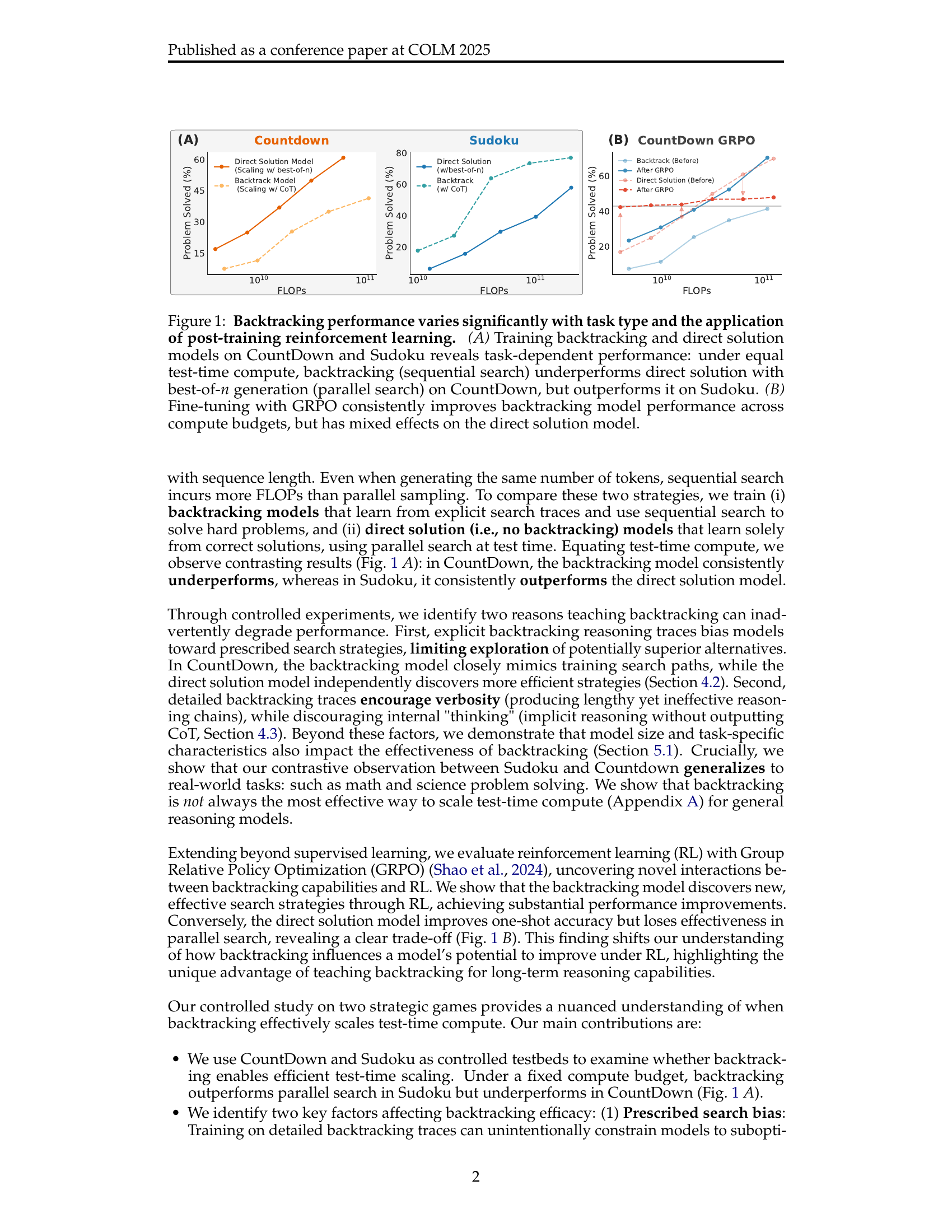
Backtracking isn't always better—we show sequential search underperforms parallel sampling on some tasks while excelling on others. The culprit? Fixed search traces and explicit chain-of-thought supervision can actually hurt LLM reasoning.
Abstract
Recent advancements in large language models (LLMs) have significantly improved their reasoning abilities, particularly through techniques involving search and backtracking. Backtracking naturally scales test-time compute by enabling sequential, linearized exploration via long chain-of-thought (CoT) generation. However, this is not the only strategy for scaling test time-compute: parallel sampling with best-of-N selection provides an alternative that generates diverse solutions simultaneously. Despite the growing adoption of sequential search, its advantages over parallel sampling—especially under a fixed compute budget—remain poorly understood. In this paper, we systematically compare these two approaches on two challenging reasoning tasks: CountDown and Sudoku. Surprisingly, we find that sequential search underperforms parallel sampling on CountDown but outperforms it on Sudoku, suggesting that backtracking is not universally beneficial.
Citation
@inproceedings{qin2025backtrack,
  title={To Backtrack or Not to Backtrack: When Sequential Search Limits Model Reasoning},
  author={Qin, Tian and Alvarez-Melis, David and Jelassi, Samy and Malach, Eran},
  booktitle={Conference on Language Modeling},
  year={2025}
}